Gifts to USAFA Falconry Team contribute to...
The United States Air Force Academy Falconry Team cares for, trains, and performs with our incredible live falcon mascots. The Academy’s falcons serve as symbols of air superiority and ambassadors for both the Academy and their species. Cadets care for the falcons daily and train them up to 5 days per week. Cadets bring falcons to football games, the Hosmer Visitor Center, and many local public events to promote the Academy and strengthen community connections.
Falcons and humans have shared a connection for thousands of years through the sport of falconry. Falconry is broadly defined as hunting with a bird of prey. Originally used in Asia and the Middle East as a method of securing food, falconry developed into a prestigious sport as new technologies made it an inefficient way of hunting. Today, falconry is still practiced all over the world.
At its founding, the United States Air Force Academy wanted to set itself apart from its sister service academies. An appropriate mascot that would represent the institution for many years to follow was key to creating a unique USAFA identity. Many options were debated. Domestic animals, like West Point’s mule or Annapolis’ goat, were quickly ruled out. The Air Force wanted something that truly reflected what the Air Force stands for and the values cadets should strive to meet. Birds of prey, like the eagle and falcon, were considered by then Superintendent Lt. Gen. Hubert R. Harmon and Commandant of Cadets Brig. Gen. Robert M. Stillman. It was decided that the mascot choice would be left to the class of 1959, the first class of cadets. Former naval officer Dr. Harold M. Webster had his peregrine falcon perform a live aerial demonstration, striking down a flying pigeon in front of the cadet wing at Lowry Air Force Base in Denver, CO. This was met with applause from the cadet wing and a near unanimous decision the following day to adopt the falcon as the Academy’s mascot.
Shortly after, the falconry program was established—before the Academy had even finished construction—with Capt Harrison H. D. Heiberg Jr. as the first Officer in Charge (OIC) of the program. The Academy wouldn’t get its first falcon, a peregrine named Mach I captured in Maryland, until a few months later. While she would escape and eventually pass away a few years later, this first falcon would lead the Academy to acquire many birds over the years from donations, in house breeding programs, and even some of the program’s staff capturing birds from the wild—as local as Colorado and as remote as Greenland. The Academy’s first white-phased gyrfalcon by the name of Athol would come from Greenland. Today, the white-phased gyrfalcon is the official mascot of the Air Force Academy, a type of falcon prized for its rarity, beauty, large size, and powerful flight.
Initially, the Academy’s falcons were not trained for the half time performance at football games that they are known for today, but the idea had quickly captured the attention of the cadet wing. Mach I was the first falcon to learn to fly to a lure. Lucifer, a prairie falcon, was the first to perform at a football game in 1956. This performance was truly groundbreaking, as the Air Force Academy was the first institution to let its mascot perform at events untethered.
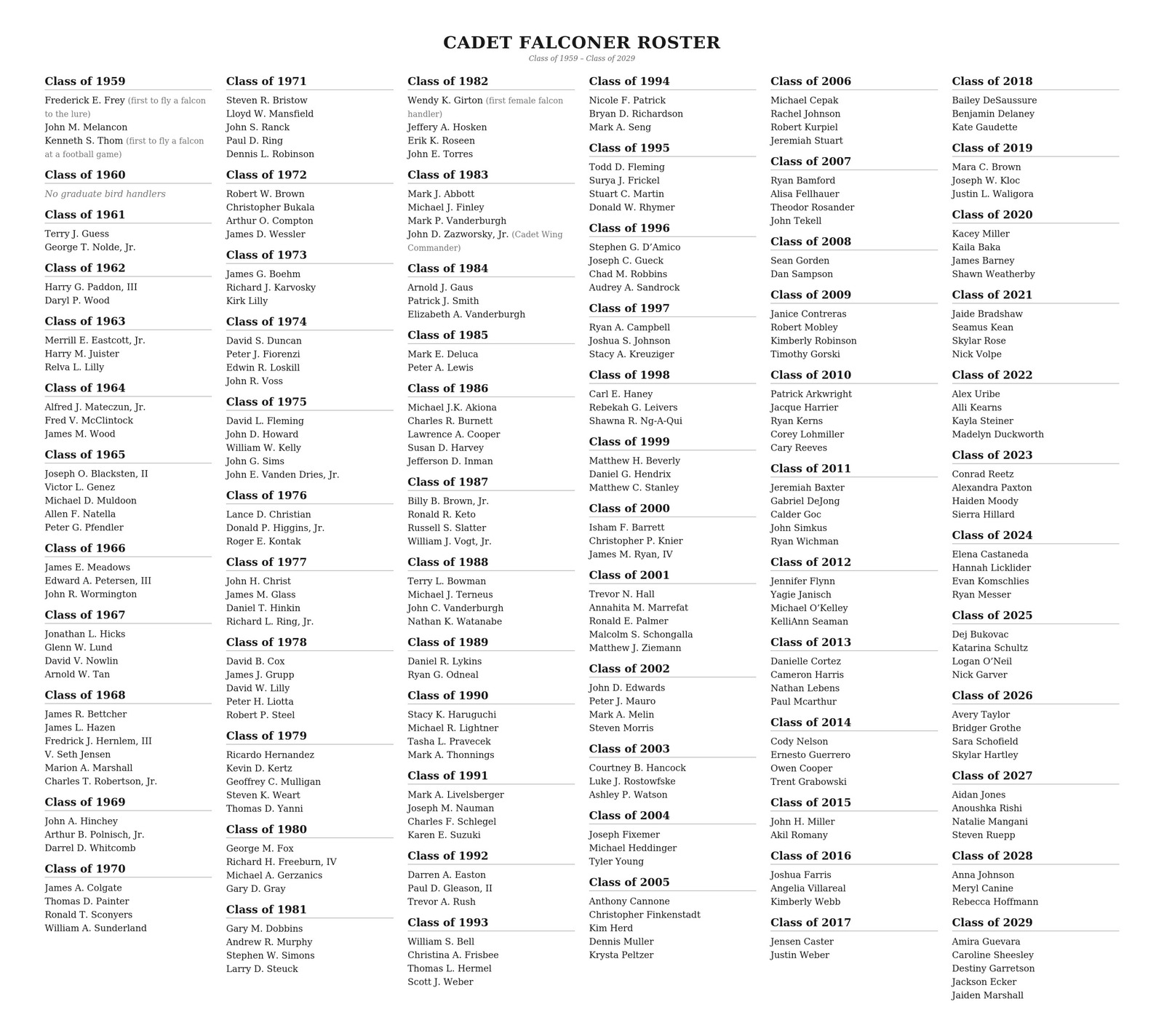
Cadets have had the honor of handling our falcon mascots and training them for performances since the first class of 1959, typically selecting four new falconers from every class. The USAFA falconry program remains active in the Academy’s public affairs world with tours, local events, and flying demonstrations.
51 days ago by Mikayla Stwertnik